Baleen whales: More rapid habitat alteration in the Atlantic than in the Pacific
environmentmarine lifepacific oceanbaleen whalesatlantic ocean
0 views - 0 viewers (visible to dev)
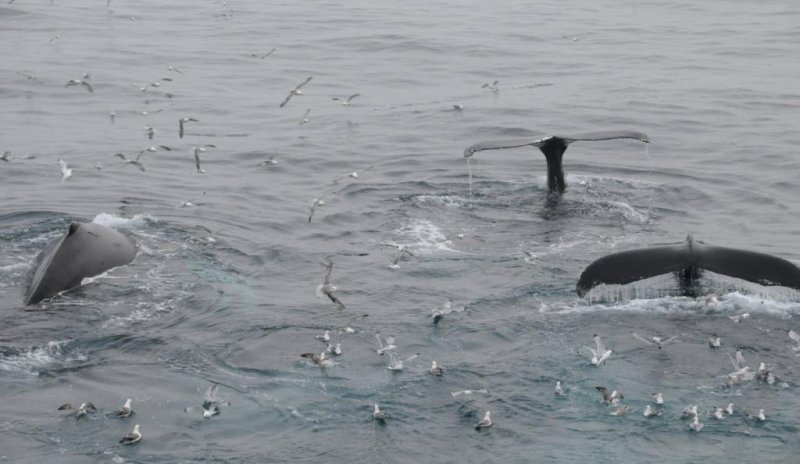
Humpback whales hunt east of Jan Mayen, (c) Leif Nøttestad / Havforskningsinstituttet
Gulf Stream provides a rich food supply in the Northeast Atlantic A new study has compared the incidence of baleen whales in the various marine areas around the Arctic. The researchers observed large differences between the locations of different species. The result: In the North Atlantic there are several hundred thousand baleen whales that migrate over long distances, while there are only a few hundred in the North Pacific. "Greenland whales, which live in the Arctic all year round, are most often found in the Pacific Ocean and the Northwest Atlantic," explains Tore Haug, research director at the Institute of Marine Research (IMR) and one of the authors of the current study. "In the North Pacific there is a robust population of around 20,000 Greenland whales, while in the Atlantic there are only a few thousand individuals. There are not many in the waters of the Northeast Atlantic. Part of the explanation is that the animals were massively hunted between 1611 and 1811. Even after more than two centuries, the population has still not been able to recover." They are also hunted in the Pacific, but there the population has recovered. "Now they are being hunted there again," says Haug. When it comes to baleen whales, such as humpback whale, minke whale, fin whale and blue whale migrating between the Arctic and warmer waters, the situation is the opposite. "In the North Atlantic, there are several hundred thousand of these migratory baleen whales, while in the North Pacific there are only a few hundred of them," says Haug. In the Atlantic, they are particularly common in the northeast and in the middle of the ocean. One important reason for this is that the warm waters of the Gulf Stream meet the cold waters of the Arctic. "That's what makes these areas very productive, with lots of krill and pelagic shoals like capuchin, mackerel and herring," explains Haug. In the summer, for example, the baleen whales migrate north to eat, before heading south towards the equator to mate as winter approaches. The new study is based on long-term monitoring and is the result of collaboration between researchers from different countries. "This is the first time that such a comparison has been made between populations in the North Atlantic and North Pacific," concludes Haug.